Data parallel pretty-printing
Apart from developing an excellent compiler with nice tools and pleasant properties, we who work on or near the Futhark project are also interested in data parallel algorithms for various problems, in particular those that do not immediately fit the array programming paradigm. A lot of these challenges are related to how to process trees or text, and in this post I will go through a couple of solutions to a problem that involves both: pretty-printing of abstract syntax trees. This is of course a problem that arises often in compilers and similar tools, but as usual, the real point is just to exercise techniques for non-obvious data parallel problems.
A representation of arithmetic trees
In this post we are going to focus on pretty-printing trees representing a specific tiny language of arithmetic expressions, and we are going to fully parenthesise every expression. I think the ideas generalise nicely, but that is for the future. Specifically, we are going to be dealing with arithmetic expressions that involve integers and operators for addition, subtraction, multiplication, and division. In Haskell, we would define a data type for such trees as follows:
data Op = Add | Sub | Mul | Div
data Expr = Num Integer
          | Op Expr Op Expr
Pretty much any functional language would do it this way. However, in Futhark, we encounter problems immediately: the language does not support recursive data types, or even recursive functions at all. This means we need to encode our trees as the only kind of arbitrary-sized aggregate data type the language does support: arrays. There are many ways to do this, but we will go for perhaps the most straightforward one: a tree is represented as an array of nodes, and a node refers to a child by storing its index of the child in the array:
type ptr = i64
type op = #add | #sub | #mul | #div
type expr = #num i32 | #op ptr op ptr
By convention, we say that the first node in an array of exprs is the root
of the tree. To be clear, I don’t think this is a nicer representation than
a civilised recursive data type - it is very easy to make indexing errors -
but it does work. (There are ways to tighten it up a little with fancy
type-level tricks, but it will never
be as nice as in Haskell.) As an example, here is how we represent the AST
corresponding to the expression (8+20)*42:
def expression : []expr =
  [#op 3 #mul 4, #num 8, #num 20, #op 1 #add 2, #num 42]
Pretty-printing
Now let’s say we want to write a function for pretty-printing this expression. It goes without saying that massively parallel pretty-printing is only potentially meaningful for huge trees, but I hope the reader will forgive me for such a tiny example.
First, we have the usual problem that Futhark as a language really has no good grasp of text. So let’s start by stating that a character is a byte:
type char = u8Let us now define some other functions we will need. First, a function that given an operator returns its character representation:
def op_char (op: op) : char =
  match op
  case #add -> '+'
  case #sub -> '-'
  case #mul -> '*'
  case #div -> '/'
Similarly, we define two functions on integers: one that returns the number of decimal digits in an integer (we assume non-negative numbers for simplicity), and one that retrieves the ith digit of an integer (counting from right to left):
def num_digits (x: i32) : i64 =
  i64.f64 (f64.log10 (f64.i32 x) + 1)

def ith_digit (x: i32) (i: i64) : char =
  '0' + u8.i32 (x / 10 ** i32.i64 i) % 10
Now we are ready to describe our first algorithm for pretty-printing these arithmetic trees. A normal algorithm is based on recursively pretty-printing the sub-trees of a node, then concatenating them (perhaps by using a clever implementation of concatenation), but recursion is not an option in Futhark. Instead, our solution is inspired by term rewriting: starting with an array containing just the root expression, we keep replacing expressions by their “expansion” into a sequence of expressions and characters, which we call tokens (not a great word; it is unrelated to lexical tokens). A token is either a character or an expression:
type token = #char char | #expr exprAt any given step in our algorithm, we are dealing with an array of these
tokens - any #char element has reached its final form, but each #expr may
expand into any number of other tokens. Essentially we need to perform some
kind of concat-map over the array, but this is notoriously not something
you can do in Futhark, as irregular arrays (arrays where elements have
different length) is not allowed. However, there is a technique called
Flattening by Expansion
that works. The idea is that if you have an array of as, a “size function”
a -> i64 that tells how many elements an a expands to, and a “get
function” a -> i64 -> b that computes the ith element of the expansion of
the a, then you can efficiently compute the final array of bs. The
precise algorithm for doing so is not important for this post - the
diku-dk/segmented package (installed
via the package
manager) provides a
function expand that we can use:
import "lib/github.com/diku-dk/segmented/segmented"The type of expand is as follows:
val expand [n] : (sz: a -> i64) -> (get: a -> i64 -> b) -> (arr: [n]a) -> ?[d].[d]bIt turns out that the num_digits and get_digit functions that we defined
above are exactly of the form that expand needs (funny how that works out),
although we of course have to write some code for handling the other kinds of
expressions as well. Here is the definition of the “size” and “get” functions
for tokens:
def token_sz (x: token) =
  match x
  case #char _ -> 1
  case #expr (#num x) -> num_digits x
  case #expr _ -> 5

def token_get [n] (E: [n]expr) (x: token) (i: i64) : token =
  match (x, i)
  case (#char c, _) -> #char c
  case (#expr (#num x), i) -> #char (ith_digit x (num_digits x - i - 1))
  case (#expr (#op _ _ _), 0) -> #char '('
  case (#expr (#op x _ _), 1) -> #expr E[x]
  case (#expr (#op _ op _), 2) -> #char (op_char op)
  case (#expr (#op _ _ y), 3) -> #expr E[y]
  case (#expr (#op _ _ _), _) -> #char ')'
There is nothing fancy here: a character expands to itself, a #num expands
to one character per digit, and an #op expands to five new tokens:
enclosing parentheses, #exprs for its children, and its operator in the
middle. The only tricky thing is that the token_get function also needs
access to the full tree. Example:
> expand token_sz (token_get expression) [#expr expression[0]]
[#char 40, #expr (#op 1 (#add) 2), #char 42, #expr (#num 42), #char 41]
If we keep using expand until only #chars are left, then those characters
end up being the pretty-printed form of the tree. This is easy enough to put
together as a function:
def get_char (x: token) =
  match x
  case #char c -> c
  case _ -> '?'

def is_char (x: token) =
  match x
  case #char _ -> true
  case _ -> false

def print [n] (es: [n]expr) : []char =
  (loop (s, continue) = ([#expr es[0]], true)
   while continue do
     (expand token_sz (token_get es) s, not (all is_char s)))
  |> (.0)
  |> map get_char
And indeed it works:
> :string print expression
((8+20)*42)
Although functional (in multiple ways), this solution has a big problem: we
are essentially traversing the tree sequentially down through the levels, so
a depth-n tree will require n iterations of the while loop in print. In
the vernacular of parallel cost
models, we say that print has
O(n) span. This is not great, as it means that for tall and skinny trees,
there will be very little parallelism, except for the redundant recomputation
of #char nodes. Actually, in this case the work of print also becomes
quadratic, without even worrying about the parallelism issue. Clearly we
would like to do better.
Doing better
We can do better by observing how the strings output during pretty-printing relate to the structure of the tree. In particular, each operator node contributes the following:
A prefix string that is printed prior to printing the left child.
An infix string that is printed after printing the left child.
A suffix string that is printed after printing the right child.
For our example, we can represent this as the following tree:
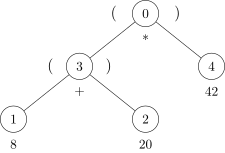
We can imagine that printing is done by walking this tree using a pre-order traversal: after printing the prefix we print the left child, and after printing the infix, we print the right child. However, this is still sequential.
The final piece of the puzzle is the concept of an Euler tour, a technique developed (as far as I know) by Tarjan and Vishkin, and which applies to a great many parallel algorithms. An Euler tour describes the order in which each node of a tree is first and last encountered during a pre-order traversal of the tree. This diagram illustrates the Euler tour for our example:
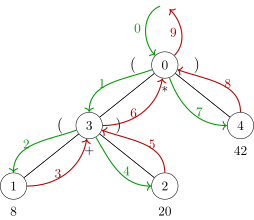
Euler tours can be computed efficiently in parallel - the details are a bit
fiddly and ultimately not important for this post. However, using the Euler
tour we can now sketch our a parallel pretty-printing algorithm. The idea is
we consider each edge in the Euler tour in parallel, and compute what it
contributes to the output - ultimately we will use expand to stitch these
contributions together. The algorithm is as follows:
- When entering a node (green edge):
- If not first child and not the root:
- Print infix string of parent.
- Print prefix string of node.
- If not first child and not the root:
- When leaving a node (red edge):
- Print suffix string of node.
There are other ways to define this algorithm, but the important part is to distribute the responsibility for the various prefix/infix/suffix parts among the edges of the Euler tour. Now let us see what this algorithm looks like when implemented in Futhark.
Implementation
We will use the euler_tour function from
diku-dk/containers, which computes
the Euler tour of a tree given its parent vector:
import "lib/github.com/diku-dk/containers/tree/euler_tour"val euler_tour [n] : (P: [n]ptr) -> [n](i64, i64)As the name suggests, the parent vector representation of a tree is an array
that for each node stores the parent of that node, such that P[p] is the
parent of node p, and the root is its own parent. It is a fairly common
representation in data parallel tree algorithms. We can easily enough
construct the parent vector for an expression tree, by having the parent
scatter its own index to the indexes
of its children (if any):
def mk_P [n] (es: [n]expr) =
  let f (p: i64) (e: expr) =
    match e
    case #num _ -> [(-1, p), (-1, p)]
    case #op x _ y -> [(x, p), (y, p)]
  let (is, ps) = unzip (flatten (map2 f (iota n) es))
  in scatter (iota n) is ps
> mk_P expression
[0, 3, 3, 0, 0]
> euler_tour (mk_P expression)
[(0, 9), (2, 3), (4, 5), (1, 6), (7, 8)]The Euler tour we get isn’t quite in the format we need: for each node, it indicates when it is first and last encountered during the Euler tour, whereas we would like a tour of node indexes, paired with whether we are going down to the node or up from the node. Fortunately, this is easily remedied:
type dir = #enter | #leave

def order_tour [n] (tour: [n](i64, i64)) : [2 * n](i64, dir) =
  let (lp, rp) = unzip tour
  in scatter (rep (-1, #enter))
             (lp ++ rp)
             (zip (iota n) (rep #enter) ++ zip (iota n) (rep #leave))
> order_tour (euler_tour (mk_P expression))
[(0, #enter), (3, #enter), (1, #enter), (1, #leave), (2, #enter),
(2, #leave), (3, #leave), (4, #enter), (4, #leave), (0, #leave)]What remains is to build up appropriate “size” and “get” functions such that
we can perform an expand of the Euler tour. Unfortunately this is a bit
tedious. Out of misguided modularity, I define separate size and get
functions for prefix, suffix, and infix strings for nodes.
def prefix_sz (e: expr) : i64 =
  match e
  case #num x -> num_digits x
  case #op _ _ _ -> 1

def prefix_get (e: expr) (i: i64) : char =
  match e
  case #num x -> (ith_digit x (num_digits x - i - 1))
  case #op _ _ _ -> '('

def suffix_sz (e: expr) : i64 =
  match e
  case #num _ -> 0
  case #op _ _ _ -> 1

def suffix_get (e: expr) (_i: i64) : char =
  match e
  case #num _ -> '?'
  case #op _ _ _ -> ')'

def infix_sz (e: expr) : i64 =
  match e
  case #num _ -> 0
  case #op _ _ _ -> 1

def infix_get (e: expr) (_i: i64) : char =
  match e
  case #num _ -> '?'
  case #op _ op _ -> op_char op
We also need to have a way of determining whether a #leave edge should
print the infix of the parent of its origin - which is exactly when it is not
the first child, and also not the root.
def is_first_child [n] (E: [n]expr) (P: [n]ptr) (p: ptr) =
  match E[P[p]]
  case #op x _ _ -> x == p
  case _ -> false

def print_parent_infix [n] (E: [n]expr) (P: [n]ptr) (p: ptr) =
  !is_first_child E P p && P[p] != p
Finally we can define a size function for an edge in the Euler tour, which also needs access to the expression and parent arrays.
def euler_sz [n] (E: [n]expr) (P: [n]ptr) (p: ptr, dir: dir) =
  match dir
  case #enter ->
    prefix_sz E[p]
    + if print_parent_infix E P p then infix_sz E[P[p]] else 0
  case #leave ->
    suffix_sz E[p]
And similarly for the get function.
def euler_get [n] (E: [n]expr) (P: [n]ptr) (p: ptr, dir: dir) (j: i64) : char =
  match (dir, print_parent_infix E P p)
  case (#enter, true) ->
    if j < infix_sz E[P[p]]
    then infix_get E[P[p]] j
    else prefix_get E[p] (j - infix_sz E[P[p]])
  case (#enter, false) ->
    prefix_get E[p] j
  case (#leave, _) ->
    suffix_get E[p] j
Finally we can put together everything and define a pretty-printing function that first computes the parent vector for the expression, then the Euler tour, and then performs an expansion.
def print_euler [n] (E: [n]expr) =
  let P = mk_P E
  let tour = order_tour (euler_tour P)
  in expand (euler_sz E P) (euler_get E P) tour
> :string print_euler expression
((8+20)*42)This function has linear overall work (as a pretty-printer should), and a span logarithmic in the size of the output, which is probably the best we can hope for.
Overall, I am quite pleased with this result. It was a fun challenge - enough to require thought, but not so hard to be frustrating, and the code is actually quite nice (once you adjust your expectations to the standards of a language like Futhark). The first pretty-printer is based on work by Teodor Stadler as part of his BSc project at DIKU. The use of Euler tours is inspired by work by Martin Elsman and Lilje Henrich Due who read about them in Guy Blelloch’s work on data parallel algorithms, and pushed further along by Aziz Rmadi, Elias Smedegaard, and Thomas Bonde Hansen, who worked on them in our course on Data Parallel Programming last year (and in particular implemented the crucial conversion from parent vector to Euler tour).
This pretty-printer is obviously quite limited, and I think I will spend some time trying to address the remaining limitations:
Minimal insertion of parentheses can probably be done by propagating a “binding environment” using some of the operations Blelloch describes for vector trees. Since the main task in constructing a vector tree is to compute the Euler tour, which we do anyway, this should not make things much more complicated.
Extension to n-ary trees is in some sense trivial (you can always split them to form binary trees), but in order to construct a generally useful pretty-printer, some more direct solution is probably necessary. The basic printing algorithm is actually not sensitive to whether the tree is binary (and neither are Euler tours), so this is mostly a question of how to design a nice API.
Speaking of library APIs, it would be nice to make the pretty-printer generic, so it can be easily instantiated with new tree types.
Overall, I think the algorithmic issues are largely solved (except item 1 above), and the main question is now how to expose pretty-printing as a reusable library - a problem that was solved decades ago in other languages, but the field of data paralellism is a wonderful place to be if you enjoy turning easy problems into hard problems…