So what is it with all the hedgehogs anyway?
Most who have browsed this web page or other Futhark material will be aware of our preoccupation with hedgehogs - both in our logo, but also in example programs. Over the years, several people have donated further illustrations of hedgehogs (blue or otherwise) to the project, and to celebrate the inauguration of our new gallery of Futhark hedgehogs, I am going to explain why we are so fond of this imagery. Warning: This post is essentially a dry, long-form explanation of a joke, which is always a highly cringeworthy activity. Feel free to skip this one.
To make it completely clear: the hedgehogs are a reference to Sonic the Hedgehog from Sega’s series of games. That is why they are often blue. The basic joke is that Sonic is fast, and Futhark is fast, and therefore there is a connection between Sonic and Futhark. Sonic is perceived as often uttering “gotta go fast”, which is also an appropriate motto for the language. Because using an official drawing of Sonic is not very creative (and certainly copyright infringement), we like to use various original drawings of blue hedgehogs instead, most of which are very unlike in design to the Sonic character. That also makes it more funny and more creative.
On the Internet, poorly drawn images of Sonic are a common joke - presumably as a parody of the many children (of all ages) with of limited artistic skill who draw pictures of Sonic, just as they draw pictures of other things they like. I do not know why poorly drawn pictures of Sonic became more popular online than poorly drawn pictures of Mario or the Halo guy. This is why many of our drawings are intentionally (as far as you know) of poor artistic quality.
I do not remember the date of my first exposure to a poorly drawn image of Sonic, but it was certainly this one:
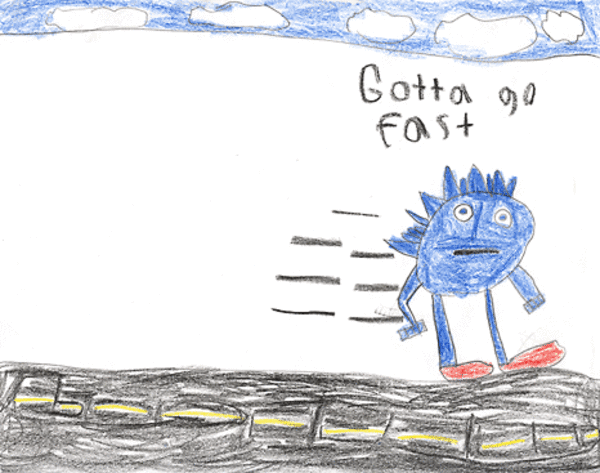
I do remember the first time I used this image, however. In the fall of 2014, I was a fresh PhD student, and while Futhark had just about received its name, it did not yet have have any mascot or logo. I was in charge of writing the Haskell part of the final exam in a course on “Advanced Programming”, which usually took the form of requiring the students to implement some novel programming language. This was about the time where Swift was released, and I decided to make a pun on its name and design, and ask the students to implement an object-oriented language called “Fast”. Because these exams are usually very dry, I thought it would be funny to include the image above in the exam text - see it on page 3 here. As it turns out, the exam was perhaps not so fun for the students, and ended up having the then-lowest passing rate ever recorded for that course, which was already notoriously brutal. This record was later surpassed, however.
The next recorded humorous application of Sonic-imagery in a Futhark context (you were warned) occurred around early 2016, about the time where Futhark was first able to live up to its motto while also doing something useful. Specifically, I wrote a program that was able to do Gaussian blurring on the GPU (the ancestor of the example linked above), and I used the “gotta go fast”-image as my example during a presentation. Despite the undeniable hilarity of poorly drawn images of Sonic, we did not really use them all that much, nor did we draw our own - possibly because at this point, few people really knew about Futhark.
When I wrote my PhD dissertation in 2017, I put a drawing of the common European hedgehog on the cover, and wrote perhaps the first justification of why hedgehogs are an appropriate logo:
Like hedgehogs, functional languages can be much faster than they might appear.
During my PhD defense, I decided to demonstrate my confidence in my work by doing my entire presentation in a slide viewer written in Futhark and Python. During one of the last slides of my presentation, a press of the button would turn the slide into a two-dimensional n-body simulation with pixels flowing freely around each other. To make it more visually interesting, I added some coloured pixels through this embedded image of “Sanic”:

Soon after, I decided to go all-in on the hedgehog motif, and also design a proper logo. I doodled something really ugly on a notepad, after which my spouse confiscated my pen and drew something much nicer which I then scanned and vectorised with Inkscape to produce the current logo.

It’s a nice logo, I think: while not particularly funny, it does reference the hedgehog joke, and it works well in various scales and colours. I am not completely satisfied with the vectorisation, since it was largely done manually, and hence the spikes do not have identical shapes. I always meant to return to it and polish it up.
After this, Futhark started getting a bit of recognition, and we regularly used pictures of Sonic in presentations and teaching and such. I characterised Futhark as a grumpy desert hedgehog in one of my favourite blog posts. The students in our course on Data Parallel Programming are encouraged to draw novel renditions of blue hedgehogs for the reports, and sometimes I extort PhD students or colleagues into drawing me hedgehogs when they need me to do them some favour.
One regret is that we have not been more systematic in collecting the various hedgehogs others have drawn, and part of the idea behind the gallery is that we will be more proactive in the future. Apart from the obvious symbolism of using poorly drawn references to Sonic to symbolise a language that is fast but perhaps also a little crude, it also makes it inviting for people of varying artistic talent to make their own contributions.
One way we exploit this bounty of hedgehogs is that we put it on mugs and award them to do students who do projects for us, give them to people who visit us, or put them in the kitchens of other universities when we visit them:
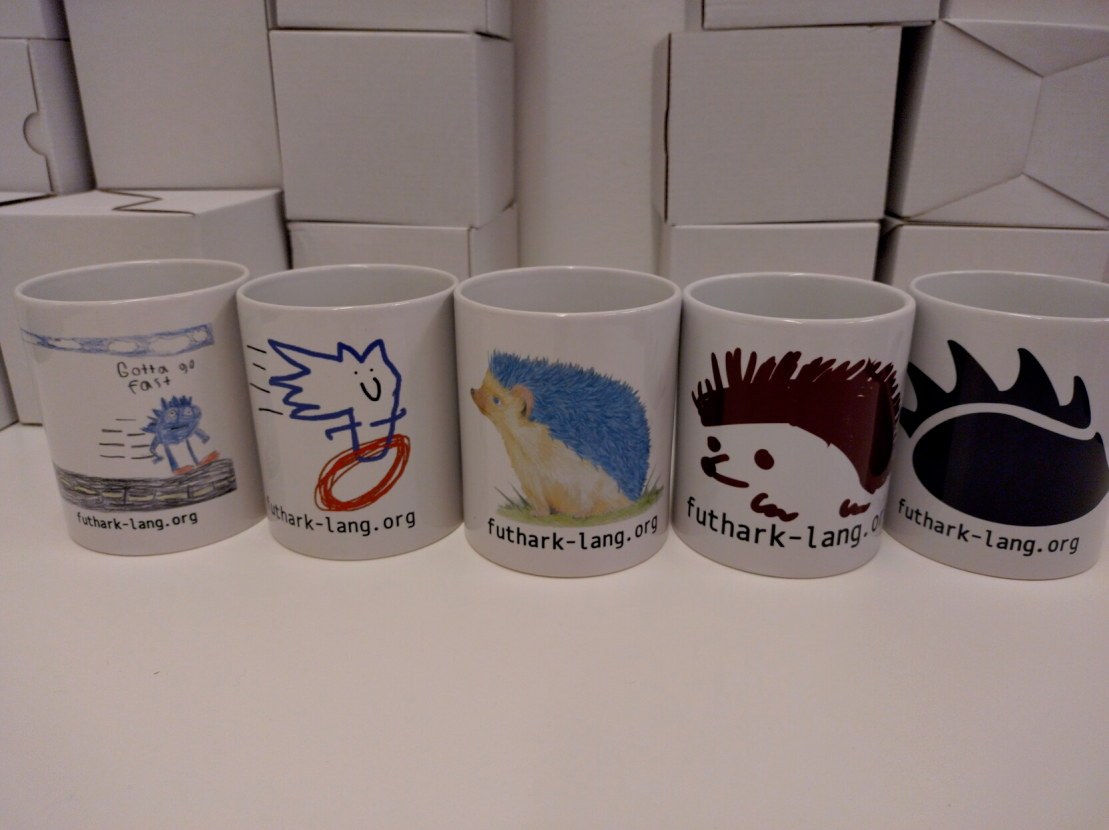
I think more people drink from our mugs than read our papers. This is called impact hacking.
I feel I should also make clear, once and for all, that I am not actually particularly fond of Sonic. While I have played the games a bit, I do not think they are particularly good. I didn’t even have a Sega console as a child, but rather a Nintendo 64, although I was much more into Legend of Zelda than Super Mario.